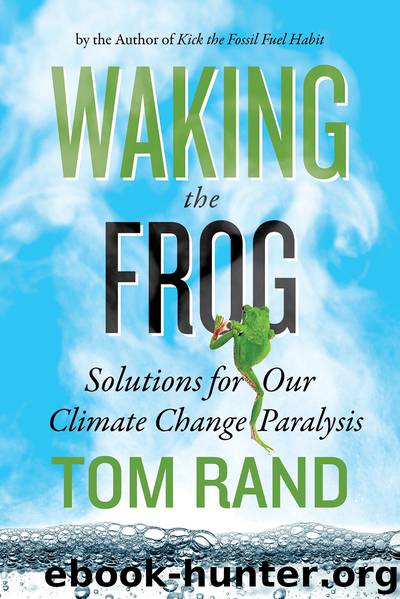
Waking the Frog by Tom Rand
Author:Tom Rand
Language: eng
Format: epub
ISBN: 9781770905252
Publisher: ECW Press Ltd
Published: 2014-01-06T16:00:00+00:00
From Dismal Science to Collaborative Expertise
There’s a reason economics is often called the dismal science. The insult is derived from the generally failed (but ongoing) effort of economists to fully capture the open-ended and complex nature of human economic behavior using only the tight, quantitative language of mathematics. Many of the humanities periodically go through stages best described as “science envy.”122 Psychologists, social scientists, and even philosophers have tried with varying degrees of success to capture the nuance of their language and theories using only empirical data and the rigor of math. Those efforts always fall short.
But economics, more often than any other social science, commits itself to the view that it’s akin to physical science. Simply put, much of modern economics — particularly that which drives belief in free and unfettered markets — is purported to be capable of fully explaining market behavior (which includes human psychology and ethical preferences) without the need for qualitative, interdisciplinary discussion. This belief is partly driven by a desire to answer complex questions of policy and political priority in an authoritative language similar to that of science. High-level policy wonks prefer hard numbers and definite answers to foggy generalizations. Economists who provide these answers can benefit from a heightened professional stature.
Math is a necessary part of good economic theory, of course. Without math, economics would be greatly impoverished, and there is great benefit from the careful, measured analysis economics can provide. The danger lies in falling too much in love with the intellectual toys that provide the precision. It’s one thing to give precise answers when possible, but it’s quite another to bluster your way through deep complexity with fake precision. Proponents of DICE, and other similar economic models, have become the standard-bearers in economic analysis of climate disruption precisely because they provide hard numbers. But sometimes foggy generalizations are all we have, and we should admit it.
The complexity of our economic life cannot be quantified, predicted, or even fully described using only math. Thomas Sargent of New York University who won the Nobel Prize in Economics in 2011 worked on something called “rational expectation theory.”123 The upshot is that the outcome of many economic situations depends on what people expect to happen. It’s recursive, which means that expectations are dependent on some market condition, which in turn is affected by expectations and so on. At the macroeconomic level, financial markets react to changes in policy, and policy-makers react to the reaction of the market. Real economics is highly complex, recursive, and, crucially, involves the interaction of human psychology with changing market conditions. Economic life cannot be predicted or fully described by mathematics because it’s just too rich and full of emotion, bias, love, aggression, and a near-infinity of other nuances of causation.
By trying to match the precision and language of science and claiming that all of ethics, psychology, and climate science can be captured in their models, many modern economists have become dangerously deluded in their ability to provide guidance on some of our toughest and most complex challenges.
Download
This site does not store any files on its server. We only index and link to content provided by other sites. Please contact the content providers to delete copyright contents if any and email us, we'll remove relevant links or contents immediately.
International Integration of the Brazilian Economy by Elias C. Grivoyannis(111057)
The Radium Girls by Kate Moore(12026)
Turbulence by E. J. Noyes(8047)
Nudge - Improving Decisions about Health, Wealth, and Happiness by Thaler Sunstein(7706)
The Black Swan by Nassim Nicholas Taleb(7128)
Rich Dad Poor Dad by Robert T. Kiyosaki(6631)
Pioneering Portfolio Management by David F. Swensen(6300)
Man-made Catastrophes and Risk Information Concealment by Dmitry Chernov & Didier Sornette(6019)
Zero to One by Peter Thiel(5798)
Secrecy World by Jake Bernstein(4751)
Millionaire: The Philanderer, Gambler, and Duelist Who Invented Modern Finance by Janet Gleeson(4478)
The Age of Surveillance Capitalism by Shoshana Zuboff(4291)
Skin in the Game by Nassim Nicholas Taleb(4248)
The Money Culture by Michael Lewis(4205)
Bullshit Jobs by David Graeber(4190)
Skin in the Game: Hidden Asymmetries in Daily Life by Nassim Nicholas Taleb(4004)
The Dhandho Investor by Mohnish Pabrai(3764)
The Wisdom of Finance by Mihir Desai(3746)
Blockchain Basics by Daniel Drescher(3580)
